
Your Embryo View
From the lab to your hands, your Embryo Report gives you a transparent view into your progress—helping you understand each step with clarity.

Inside the embryology lab…
The view gets personal.
Under the scope, that’s your embryo.
Now, you can see your embryo too!
Your Embryo. Your View.
Your personalized Embryo Report brings clarity to every step.

View Embryo Report
Powered by ALife, your Embryo Report delivers a new level of visibility—giving you insight into your embryo like never before.
Preview a Sample ReportEmbryo Development
Fertilization begins in the embryology lab, where egg and sperm are carefully brought together under controlled conditions to create an embryo.
Embryo grading and development are key parts of the IVF process—they help embryologists assess which embryos have the best chance of leading to a successful pregnancy.
What to know about
Developing to the Blastocyst Stage
After fertilization, embryos are carefully cultured in a specialized incubator for 5–7 days. During this time, the cells will hopefully divide and develop into blastocysts, signifying they are maturing to evolve into a healthy embryo. Throughout the process, the embryology team closely monitors each embryo’s progress, tracking how it’s growing and evolving.
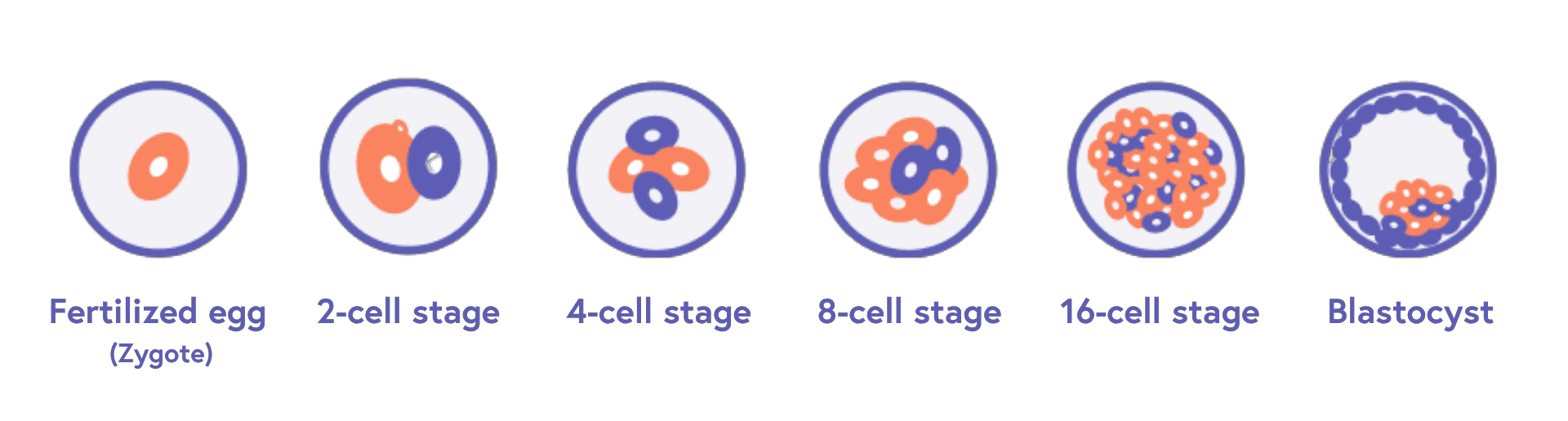
How to understand
Embryo Grading
It’s like a report card for your embryo. Embryo grading is a system used to describe the morphological appearance (the form and structure) of any embryo. Each grade includes a number and two letters. The number reflects growth and expansion, while the letters evaluate what’s happening on the inside—and the outside. The assessment aids the team in selecting the best embryo for transfer.

Expansion
The number of the embryo grade represent how expanded the embryo cavity is. 1-2 is the best grade. The embryo must eventually fully hatch in order to implant.

Inner Cell Mass (ICM)
The first letter represents the “inner cell mass”. “A” is the best grade with many tightly packed cells.

Trophectoderm (TE)
The second letter represents the outer layer of cells. “A” is the best grade with lots of cells.
High Quality Embryos
Embryos that reach the blastocyst stage are ready for the next step—whether that’s freezing, biopsy for Preimplantation Genetic Testing (PGT), or transfer into the uterus.
Before starting treatment, patients work closely with their care team to make important decisions about their plan, including whether to pursue a fresh or frozen embryo transfer, and whether PGT testing is right for them.
At FCI, our lab follows strict criteria when selecting embryos for transfer or freezing. We freeze only high-quality blastocysts—typically graded 1–2 with AA, AB, BA, or BB classifications—because these embryos have a greater than 97% chance of surviving the thaw process.

Who Gets The Embryo Report?
- Patients who undergo an egg retrieval cycle with fertilization and have embryos that develop to the blastocyst stage will receive an embryo report.
- Your care team will send the report through your patient portal messages, and it will also be available in the uploads section of your patient portal.
- Have questions? Reach out to your care team or connect with your physician—we’re here to guide you every step of the way.
